_edited_edited.png)

Yacht Safety Equipment Checklist
From Speeders to Supers
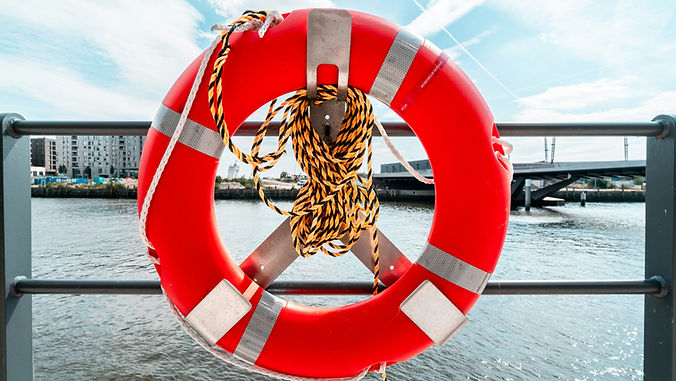
Safety equipment isn't one-size-fits-all. What belongs aboard a center console making a short run across the bay is very different from what belongs aboard a 120-foot cruiser headed offshore for a week — and the gap only widens once crew, passenger count, and distance from help enter the picture. This checklist breaks down what to carry by vessel class, from speeders through superyachts, with an eye toward the specific realities of operating in Baja California Sur.
Two things make this region a little different from most U.S. cruising grounds. First, Mexican maritime law sets its own baseline requirements, enforced through the local Capitanía de Puerto under the Secretaría de Marina (SEMAR) — vessels operating here need a valid certificado de seguridad, and foreign-flagged recreational vessels are required to register their arrival with the capitanía of the first Mexican port they enter. Second, much of what makes Baja spectacular — remote anchorages, island chains, long stretches of undeveloped coastline — also means limited cell coverage, real distances from the nearest help, and a climate that adds its own equipment demands. Everything below accounts for both.
Universal Baseline: Every Vessel, Every Class
Regardless of size or use case, every vessel on the water should carry:
Personal flotation devices — one properly fitted PFD per person aboard, plus at least one throwable flotation device
Fire extinguishers rated appropriately for the vessel's size and fuel type, mounted where they're actually reachable in an emergency
A sound-signaling device (horn or whistle) and functioning navigation lights
Visual distress signals — day and night flares at minimum
A first aid kit, sized to the vessel and checked periodically for expired contents
A VHF marine radio, fixed-mount or handheld depending on vessel size
A compass and a ground tackle setup (anchor and rode) appropriate to the vessel
A bilge pump, manual or electric
An engine cut-off (kill switch) lanyard, worn and used — not just stowed
Sun protection and extra drinking water. This isn't a formality in Baja. Heat-related illness is a real risk on the water here, and it belongs on the safety list, not just the comfort list.
Current vessel documentation aboard, including proof of the Mexican safety certificate where applicable
Speeders: Day and Performance Boats
Center consoles, performance day boats, and tenders typically operate close to shore, for short durations, without overnight capability — but they're also often run at higher speeds with less margin for error.
Beyond the baseline, prioritize:
Type III PFDs for every passenger, sized correctly — not just present in a locker
A waterproof handheld VHF, since a fixed radio isn't always standard on smaller boats and cell service disappears quickly once you're away from town
A tow line, since mechanical failure on a performance boat a few miles offshore is a common and preventable inconvenience that becomes a real problem without one
A dry bag for phones and electronics — practical, but also a safety item once you consider how much modern emergency communication depends on a working phone
Enforced kill-switch use, especially with multiple people aboard and higher speeds involved; this single habit prevents one of the most common serious accidents on boats this size
Express Cruisers
Express cruisers occupy the middle ground — capable of longer runs (La Paz to the islands, Cabo to Cabo Pulmo and back) and sometimes an overnight aboard, with enclosed cabin space that introduces new risks alongside new comforts.
Add to the baseline:
Additional PFDs including a Type IV throwable cushion or ring
A carbon monoxide detector, mandatory in any vessel with an enclosed cabin — CO risk is easy to underestimate on a boat this size
Fire suppression in the engine compartment, fixed or semi-fixed rather than relying solely on a handheld extinguisher
Redundant bilge pumping — a primary pump plus a float-switch-activated backup
SOLAS-grade or coastal-rated flares, and a radar reflector if the vessel doesn't already have one built in
A more complete first aid or trauma kit, appropriate for a longer run without quick access to shore
An EPIRB, worth adding at this size class once runs start extending beyond easy VHF range or cell coverage — which, in the Sea of Cortez, happens sooner than owners often expect
Cruisers
Larger motor yachts built for extended cruising or live-aboard use carry passengers and often crew for days at a time, frequently well outside cell range, which changes what "safety equipment" needs to mean.
Add to the express cruiser list:
A registered 406 MHz GPS-enabled EPIRB — registration matters as much as the unit itself; an unregistered beacon delays rescue response
An offshore-rated life raft, sized to the vessel's full passenger and crew capacity, with a current service record
Automatic fixed fire suppression in the engine room, with manual backup activation
Carbon monoxide detectors in every sleeping area, not just near the engine room
A man-overboard recovery system — a Lifesling or equivalent, plus a boarding ladder that's actually usable from the water
Satellite communication — a satellite phone or a system like Starlink, ideally backed up by a handheld satellite messenger (a Garmin inReach or similar). This is one of the highest-value additions for Baja cruising specifically: large stretches of the Sea of Cortez and the outer islands have no cell signal at all, and a working communication method shouldn't depend on a single system
A damage control kit — soft wood plugs sized to the vessel's thru-hulls, a collision mat, and basic tools for a below-waterline emergency
Hurricane season gear — additional dock lines, chafe gear, and a storm anchor, relevant given the region's June–November season
AIS, both for collision avoidance and because it makes a vessel easier to locate in an emergency
Supers
Superyachts carry their own regulatory weight, and equipment at this scale is less a checklist than a compliance framework — but the underlying logic is the same, scaled up.
At this level, expect and plan for:
Flag-state or SOLAS-aligned compliance, often under a code like the MCA's Large Yacht Code (LY2/LY3) or an equivalent, depending on tonnage, flag state, and whether the vessel operates privately or commercially
Multiple life rafts, sized with redundancy for the full complement of guests and crew, not just exact capacity
Fixed fire suppression throughout the vessel — engine room, and typically a dedicated wet-chemical system in the galley, plus drencher systems on larger yachts where applicable
Crew trained to STCW basic safety standards, with regular, logged safety drills and defined muster stations
Integrated man-overboard systems tied into onboard electronics and AIS, rather than relying on visual spotting alone
Dedicated ditch bags at each life raft station, fully stocked and checked on a schedule
A more advanced onboard medical capability — a proper medical kit at minimum, an AED, and on larger yachts sometimes a trained medical officer
Scheduled third-party safety audits and flag-state inspections, which at this size are typically a regulatory requirement rather than an option
Why Baja California Sur Changes the Calculus
A few regional realities are worth calling out directly, because they change what "adequately equipped" actually means here compared to more developed cruising grounds:
Cell coverage is not reliable once you leave the main corridor. La Paz, Cabo San Lucas, and San José del Cabo have coverage; the islands, East Cape anchorages, and much of the outer Sea of Cortez do not. Satellite communication moves from "nice to have" to genuinely important sooner here than most owners expect.
Heat is a safety issue, not just a comfort issue. Dehydration and heat illness are real risks, especially on smaller open boats without shade, and should factor into how much water and sun protection is carried as a matter of course.
Hurricane and chubasco season (June–November) demands its own preparation, covered in more detail in our regional maintenance checklist — but from a pure safety-equipment standpoint, it means storm anchors, extra chafe gear, and a real weather-monitoring routine, not just haul-out planning.
Search and rescue response can take longer in remote anchorages. SEMAR, via the Mexican Navy, is the primary search and rescue authority in Mexican waters, but response times understandably vary with how remote the location is. That reality is exactly why redundancy — a second communication method, a properly stocked ditch bag, equipment that doesn't depend on cell service — matters more here than in a cruising ground with faster backup close at hand.
Keeping Equipment Current
Safety equipment that's expired or unserviced is, functionally, not safety equipment. A few intervals worth tracking on every vessel: flares have hard expiration dates; fire extinguishers need periodic recharge or replacement, not just a glance at the gauge; EPIRB batteries typically need replacement around the five-year mark, alongside an annual self-test; life rafts require certified servicing on a fixed interval, commonly every one to three years depending on type; and CO detectors have their own service life, often five to seven years, after which they should be replaced outright rather than trusted.
Getting Your Vessel Properly Equipped
The right safety loadout depends on your vessel's class, how you actually use it, and where you cruise — a checklist is a starting point, not a substitute for a proper assessment. Praetor Yacht Group's maintenance and administration team can run a full safety equipment audit tailored to your vessel, confirm you're meeting SEMAR and Capitanía de Puerto requirements, and keep expiration and service dates on track so nothing lapses without your knowing.
Reach out to our team to schedule a safety equipment review for your vessel.